How AI Risk Assessment Tools Help Identify and Manage Risks
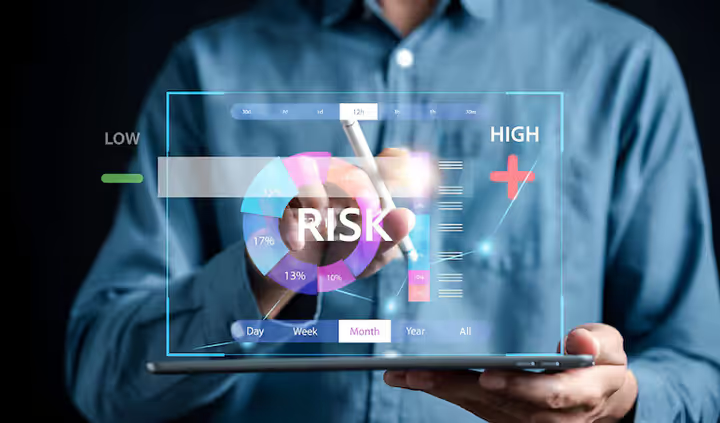
AI risk assessment tools are digital systems that use artificial intelligence techniques to analyze data and identify potential risks across different activities and industries. These tools exist to support decision-making by processing large volumes of information that may be difficult for humans to evaluate consistently or quickly.
Traditionally, risk assessment relied on manual reviews, historical records, and expert judgment. While these approaches remain valuable, they can be time-consuming and may miss patterns hidden in complex datasets. AI risk assessment tools were developed to complement traditional methods by identifying trends, correlations, and early warning signals.
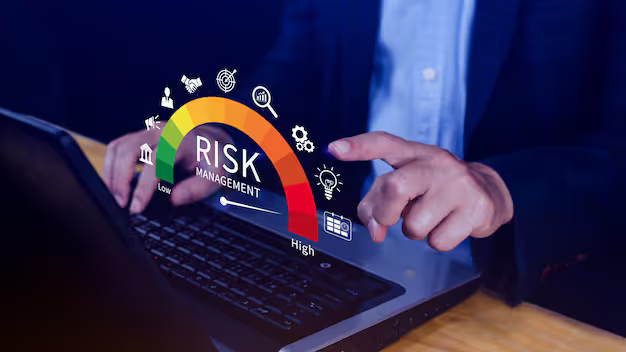
The goal of these tools is not to predict the future with certainty, but to improve awareness of possible risks so that individuals and organizations can plan and respond more effectively.
Importance
AI risk assessment tools matter because uncertainty is present in many areas of modern life, including business operations, technology use, healthcare planning, and financial decision-making. As systems become more interconnected, risks can arise quickly and spread across multiple areas.
Why AI-based risk assessment is important today
Several factors have increased the need for advanced risk assessment approaches:
-
Growing volumes of digital data
-
Increased complexity of systems and processes
-
Faster decision-making requirements
-
Higher expectations for accuracy and accountability
AI tools help address these challenges by supporting structured and repeatable analysis rather than relying only on manual judgment.
Who benefits from AI risk assessment tools
-
Businesses managing operational or financial risks
-
Technology teams monitoring system reliability
-
Healthcare organizations planning patient safety measures
-
Public sector agencies evaluating policy impacts
-
Researchers and analysts studying complex systems
By improving visibility into potential risks, these tools help different groups plan more responsibly.
How AI Risk Assessment Tools Work
AI risk assessment tools analyze data using algorithms that learn from patterns and historical information. They can process structured data, such as numerical records, and unstructured data, such as text or logs.
Core components of AI risk assessment tools
-
Data collection from multiple sources
-
Data cleaning and normalization
-
Pattern recognition and modeling
-
Risk scoring or categorization
-
Ongoing updates based on new information
The table below shows common functions and their purpose.
| Function | Purpose |
|---|---|
| Data analysis | Identify trends and anomalies |
| Pattern recognition | Detect early risk signals |
| Scoring systems | Rank risk levels |
| Monitoring | Track changes over time |
| Reporting | Support decision-making |
These components work together to provide a clearer picture of potential risks.
Types of Risks AI Tools Can Help Assess
AI risk assessment tools are used across different risk categories.
Common risk areas
-
Operational risks related to processes or systems
-
Financial risks such as fraud or credit exposure
-
Cybersecurity risks including unauthorized access
-
Compliance risks linked to regulations
-
Safety and health-related risks
The table below illustrates examples of AI-supported risk areas.
| Risk Area | Example Use |
|---|---|
| Operations | Process disruption detection |
| Finance | Transaction pattern review |
| Technology | System failure monitoring |
| Compliance | Policy deviation alerts |
| Health and safety | Incident trend analysis |
Understanding the scope helps set realistic expectations for AI-based risk tools.
Recent Updates
AI risk assessment tools have continued to evolve alongside advancements in artificial intelligence and data governance.
Key developments during 2024–2025
-
In April 2024, increased focus on explainable AI to improve transparency in risk scoring
-
In September 2024, broader adoption of AI monitoring tools for real-time risk detection
-
By February 2025, stronger emphasis on human oversight in AI-driven risk assessments
There has also been growing attention to reducing bias in risk models and ensuring that AI outputs are understandable to non-technical users.
Benefits of Using AI Risk Assessment Tools
AI risk assessment tools offer several practical benefits when used responsibly.
Key advantages
-
Faster analysis of large datasets
-
Consistent application of assessment criteria
-
Early identification of potential issues
-
Support for proactive planning
The table below compares traditional and AI-supported approaches.
| Aspect | Traditional Assessment | AI-Supported Assessment |
|---|---|---|
| Speed | Slower | Faster |
| Data volume | Limited | Large-scale |
| Consistency | Variable | More consistent |
| Monitoring | Periodic | Continuous |
These benefits help improve readiness rather than eliminate risk entirely.
Limitations and Considerations
While AI tools are useful, they also have limitations.
Important considerations
-
Dependence on data quality
-
Risk of biased input data
-
Need for human interpretation
-
Limited context awareness
AI risk assessment tools are most effective when combined with expert review and clear governance practices.
Laws or Policies
The use of AI risk assessment tools is influenced by data protection, technology, and industry-specific regulations.
In India
-
Governed by the Digital Personal Data Protection Act for data handling
-
AI systems must comply with consumer protection principles
-
Sector-specific regulations apply in finance, healthcare, and infrastructure
Broader regulatory considerations
-
Transparency in automated decision-making
-
Accountability for AI-assisted outcomes
-
Protection of personal and sensitive data
These policies encourage responsible and ethical use of AI technologies.
Ethical and Responsible Use of AI Risk Tools
Responsible use of AI risk assessment tools involves more than technical accuracy.
Ethical practices include
-
Clear documentation of how tools work
-
Human review of high-impact decisions
-
Regular audits of data and models
-
Respect for privacy and consent
Ethical practices help build trust and reduce unintended consequences.
Tools and Resources
Various tools and resources support learning and implementation of AI risk assessment.
Educational resources
-
Government AI policy portals
-
Academic research publications
-
Industry best-practice guides
Technical and planning tools
-
Risk assessment templates
-
Data quality checklists
-
Model evaluation frameworks
Monitoring and review resources
-
Audit and compliance dashboards
-
Reporting and visualization tools
-
Training materials for non-technical users
These resources support informed and careful use rather than promotion.
Example of a Risk Assessment Workflow
The table below outlines a simplified AI-supported risk workflow.
| Stage | Purpose |
|---|---|
| Data gathering | Collect relevant information |
| Analysis | Identify patterns |
| Scoring | Estimate risk levels |
| Review | Human validation |
| Action | Risk mitigation planning |
Following a structured workflow improves clarity and accountability.
FAQs
What are AI risk assessment tools?
AI risk assessment tools are systems that use artificial intelligence to analyze data and identify potential risks to support decision-making.
Do AI risk tools replace human judgment?
No. They are designed to support human decision-makers, not replace professional judgment.
Are AI risk assessment tools accurate?
Accuracy depends on data quality, model design, and ongoing review. Results should always be interpreted carefully.
Where are AI risk assessment tools commonly used?
They are used in areas such as finance, healthcare, technology, public policy, and operational planning.
Are AI risk assessment tools regulated?
Yes. Their use is influenced by data protection laws, industry regulations, and ethical guidelines.
Final Thoughts
AI risk assessment tools provide a structured way to identify and manage potential risks in complex environments. By analyzing large datasets and highlighting patterns, these tools support earlier awareness and more informed planning.
Their value lies in improving consistency and visibility rather than eliminating uncertainty. When combined with human oversight, clear policies, and ethical practices, AI risk assessment tools can contribute to responsible risk management.