Learn How Data Analytics Helps Make Smarter Decisions and Improve Outcomes
Data Analytics refers to the process of collecting, organizing, and analyzing data to identify patterns, trends, and useful insights. It helps individuals and organizations understand information more clearly and make decisions based on evidence rather than assumptions.
The concept of analyzing data has existed for many years, but it has evolved significantly with the growth of digital technology. In earlier times, data was limited and often recorded manually. Today, large volumes of data are generated from digital platforms, devices, and systems, creating new opportunities for analysis.
Data Analytics includes different approaches such as descriptive analysis, which explains what has happened, diagnostic analysis, which explores why it happened, predictive analysis, which estimates what may happen next, and prescriptive analysis, which suggests possible actions. These approaches work together to provide a comprehensive understanding of data.
With the rise of computers, cloud computing, and advanced algorithms, Data Analytics has become more accessible and widely used. It is now applied in areas such as healthcare, education, finance, transportation, and public services.
Importance
Data Analytics plays a crucial role in improving decision-making and outcomes. By transforming raw data into meaningful insights, it helps individuals and organizations understand situations more clearly and act more effectively.
One key benefit is informed decision-making. Instead of relying on guesswork, decisions can be based on actual data trends and patterns. This reduces uncertainty and improves accuracy.
Another important aspect is efficiency. Data Analytics can identify inefficiencies in processes and suggest ways to improve them. This helps save time and resources while enhancing overall performance.
It addresses several real-world challenges:
- Understanding complex information, by organizing large datasets into clear insights.
- Identifying trends, which helps predict future outcomes and plan accordingly.
- Improving resource allocation, by highlighting areas that require attention.
- Supporting risk management, by detecting potential issues early.
For everyday users, Data Analytics influences many aspects of daily life. From personalized recommendations to traffic updates and healthcare insights, data-driven decisions contribute to smoother experiences.
Recent Updates
Recent developments in Data Analytics reflect rapid advancements in technology and data processing capabilities. One major trend is the integration of artificial intelligence and machine learning. These technologies enable systems to analyze data more efficiently and uncover deeper insights.
Another trend is real-time analytics. Instead of analyzing data after events occur, systems can now process information instantly. This allows for quicker responses and more dynamic decision-making.
There is also growing use of cloud-based analytics platforms. These platforms allow users to access data and analytical tools from different locations, supporting collaboration and scalability.
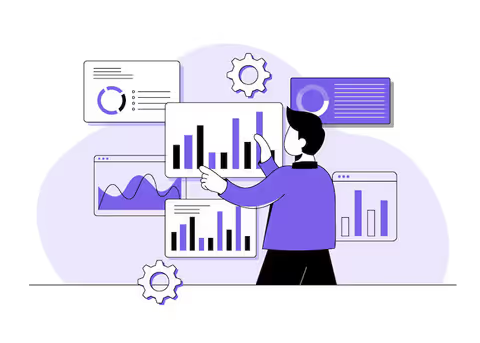
Data visualization has improved as well. Modern tools provide interactive dashboards and visual representations that make complex data easier to understand for non-technical users.
Additionally, there is increased focus on data governance and ethical use. Organizations are paying more attention to how data is collected, stored, and used responsibly.
Laws or Policies
Data Analytics is influenced by various laws and policies related to data protection, privacy, and security. These regulations ensure that data is handled responsibly and that individuals’ rights are protected.
In India, the Digital Personal Data Protection Act outlines rules for collecting and processing personal data. It emphasizes consent, transparency, and security. Organizations using Data Analytics must ensure that they comply with these requirements.
Other important policy areas include:
- Data privacy regulations, which protect personal information from misuse.
- Cybersecurity standards, ensuring that data systems are secure.
- Data governance frameworks, which define how data is managed and shared.
- Sector-specific guidelines, such as those in healthcare or finance, which may impose additional requirements.
These policies help maintain trust in data-driven systems and ensure that Data Analytics is used ethically.
Tools and Resources
A wide range of tools and resources support Data Analytics, making it easier to collect, process, and interpret data. These tools vary in complexity and are used by both beginners and advanced users.
Common categories include:
- Spreadsheet tools, which allow basic data organization and analysis.
- Data visualization platforms, which create charts and dashboards for better understanding.
- Statistical software, which performs advanced analysis and modeling.
- Database management systems, which store and organize large datasets.
- Cloud-based analytics platforms, which provide scalable data processing capabilities.
Below is a table summarizing key types of Data Analytics:
| Type of Analysis | Description |
|---|---|
| Descriptive | Explains what has happened based on past data |
| Diagnostic | Identifies reasons behind observed outcomes |
| Predictive | Estimates future trends using historical data |
| Prescriptive | Suggests actions based on analysis results |
Examples of commonly used tools include Microsoft Excel, Google Analytics, Tableau, Power BI, and Python-based libraries. These tools help users explore data and generate insights effectively.
Educational resources such as online courses, tutorials, and documentation guides also support learning and application of Data Analytics.
FAQs
What is Data Analytics and why is it important?
Data Analytics is the process of analyzing data to identify patterns and insights. It is important because it supports informed decision-making and helps improve outcomes in various fields.
How does Data Analytics help in decision-making?
Data Analytics provides evidence-based insights that help individuals and organizations make decisions with greater accuracy and confidence.
Can Data Analytics be used in everyday life?
Yes, Data Analytics is used in many daily applications, such as navigation systems, health tracking, and personalized content recommendations.
What tools are commonly used in Data Analytics?
Common tools include spreadsheet software, visualization platforms, statistical tools, and cloud-based analytics systems.
Is Data Analytics only for large organizations?
No, Data Analytics can be used by individuals, small organizations, and large enterprises. Its applications vary depending on the scale and purpose.
Conclusion
Data Analytics is a powerful approach to understanding information and improving decision-making. By analyzing patterns and trends, it helps individuals and organizations achieve better outcomes. Advances in technology continue to expand its capabilities, making it more accessible and effective. Understanding the basics of Data Analytics provides valuable insight into how data shapes modern life.